Pages

Showing posts with label journalism. Show all posts

5 Examples of an Inflection Point for Maps on the Web

Monday, June 3, 2013
Some recent thoughts by Brandon Rosage reminded me that webcartographics (I should trademark that one) are the midst of a change. Since the dawn of Mapserver, we've been building maps into our websites in a segregated fashion, often treating the map as little more than an <iframe> keyed to a CMS. This works well enough in a short blog or location description, but there are more engaging stories to tell with cartography, and better ways to deal with UX complexity than just adding more markers.

Fortunately some great developers are steadily building tighter integration between geography and web design. My favorite recent examples of this follow:

1. Chasing the Boston Bombers

A maps-in-the-background piece on the Boston bombings from the New York Times Graphics Department uses a Google static map as a location-based table of contents to a scrollable storyline highlighted with more maps and photos.

2. The Royal Navy in WWI

From Vizzuality, a moving record of Allied ship traffic in WWI was derived from their work crowdsourcing the transcription of old ships logs. This is more of a show than an interactive piece, which works perfectly to illustrate the flurry of activity around major geopolitical events.

3. The Adventure of the Bruce-Partington Plans

Young Hahn's Mapbox-based adaptation of a Sherlock Holmes storyline changes the click-and-drag paradigm of the web map by tying map navigation exlusively to a scrolling text storyline. Unlike the NYTimes piece above, the map does move - but only as the narrative progresses. Bonus points that it's responsive, making this an equally-rich read on mobile.

4. Crowdmap's New Layout

Crowdmap has some great potential here, though it's still being pulled in several directions by varying stakeholders. The previous version was a codeless window into Ushahidi's functionality, and that was great for easy access to a map-within-a-CMS. But with the current iteration they've tried to bring the focus to a map driven by its content, rather than content accessed via a map.

5. Hurricane Sandy Coastal Impacts

Another entry in the the journalism category, this tour-de-force from Derek Watkins treats the coastal axis (North-to-South) as a narrative, attaching aerial photos seamlessly to a thematic map built with the D3 javascript library. Perhaps the coolest part of this one is what it implies - D3 is one of the best emerging tools for breaking maps out of "Plugin" status and letting them interact seamlessly with the architecture of web design. This is looking more and more like a window into the future of maps on the web.
Read more ...

Open Thresholds

Friday, January 18, 2013
They went too far, clearly.

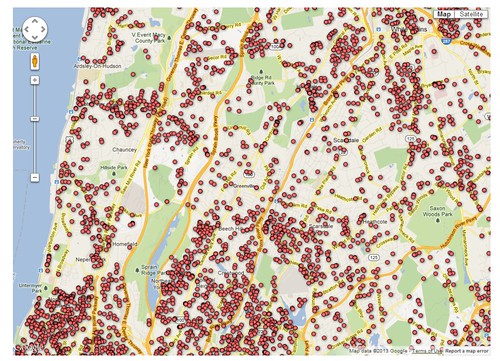
In publishing the precise locations and names of all the permitted handgun owners in two New York Counties, the New York Journal-News has done a serious disservice to data journalists in particular. More broadly, they may have made things more difficult for the "Open Data" community at large.

Got guns?
But a lot of ink and rage has already been leveled at the J-N for this; in the New York Times, David Carr pointed out that even in an era of minimized privacy this was a step too far, lacking in due diligence. Jeff Sonderman in Poynter noted that the context matters kind of a lot - that the timing and lack of justification seemed to associate the mapped gun owners with the Sandy Hook massacre. Sonderman also had sage words for those sitting on piles of prospective open-data boodle:

"If you can’t come up with a better reason than 'because we can' or 'because we think it would look cool,' stop here, you’re about to data dump."

So the smarter folks have weighed in on the implications for journalism and data management, but this awkward business leaves me with two HUMUNGO-GONZO TAKE-HOME MESSAGES for the geographic opendata community:

1. Aggregate to Support the Story.

We - as a society - are flat-out not comfortable with publishing the name and location of individuals. At the very least strip the identifiers out of your points; better still, aggregate the points to coarser-scale geographic units. Census blocks work fantastically well for detailed data like this, and I hear that hexagonal bins are all the rage these days. More importantly, the coarser scale brings context and emphasizes patterns; that's where the story is at.

2. QA/QC, Punks.

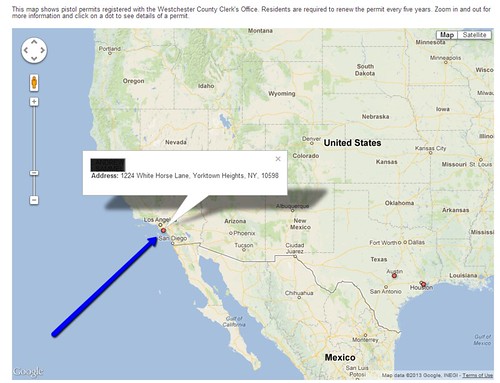
Google Fusion Tables - for all its awesomeness - is an extremely blunt instrument for data journalism. Styles, filters and deployment are all very limited for getting your message out. But fusion tables also make it a little too easy to presume accuracy. The handgun ownership maps were piped through the Google geocoding engine (by all accounts the most accurate one out there today) and deposited in their supposed locations on the map. The Journal-News may have tried to clean up the output before publishing, but they didn't catch a few that missed their targets and landed in Burbank and Houston. If you're going to publish something like this, sloppiness is profoundly unhelpful.
Yeah, that guy doesn't live there.


Geosprocket built an application for the Burlington Free Press (coincidentally a sister publication of the Journal-News; don't run out of free article views now!) in late 2012, in which we tried to show the month-to-month patterns of burglaries in the city of Burlington. The data was provided by the BPD in response to a FOIA request by the Free Press, and it was extremely specific - down to the address of the incident. The context and story were clear - there's a February bump in Nighttime Burglaries - and we tailored the visualization to focus on that pattern.

BTVCrime - via the Burlington Free Press
At the time I thought we were being conscientious by stripping out the address text and using only the badge number of the responding officer, but in retrospect I would have aggregated these to the census block level. With the cool tools available today, it's a relative snap to make a polygon flash every time an incident occurs, and let the incidents stack up in accumulated color (though not so much of a snap that I'll do it for a blog post).

Basically, the Journal-News handgun owners' map has caused me to rethink a few of my own methods, and I hope provided us all with a sense of the threshold between responsible data journalism and data dumping.

Read more ...